
For most people, 1440p on a 27-inch monitor is the sweet spot: it looks noticeably sharper than 1080p without the scaling quirks and GPU demands of 4K. If you do photo or video work, 4K makes more sense because it gives you more detail and workspace. And if you're buying on a budget or mostly using a portable screen for classes, office tasks, or casual gaming, 1080p is still completely fine. The trick is not to chase the highest number — it's to match resolution to screen size, viewing distance, and what you actually do every day.
1. What Is Monitor Resolution? The Basics Explained
Resolution Cheat Sheet
| Label | Resolution | Common Name | Typical Use |
|---|---|---|---|
| 1080p | 1920 × 1080 | Full HD / FHD | Budget monitors, gaming, school, office |
| 1440p | 2560 × 1440 | QHD / WQHD | Best all-around choice for desktop use |
| 4K | 3840 × 2160 | UHD | Creative work, premium gaming, large screens |
| 5K | 5120 × 2880 | 5K | Pro editing, design, high-end productivity |
What Exactly Is Monitor Resolution?
At the simplest level, monitor resolution is the number of pixels on your screen, written as width × height. So when you see 1920 × 1080, it means the screen has 1,920 pixels across and 1,080 pixels down. More pixels usually means more detail — but only if the screen size and viewing distance make those extra pixels visible.

A few terms matter here:
- Native resolution: the monitor’s real, physical pixel grid — the resolution it is built to display most clearly
- PPI (pixels per inch): how tightly those pixels are packed
- Aspect ratio: the shape of the screen, such as 16:9 or 16:10
- Content resolution vs. display resolution: a 4K video can play on a 1080p monitor, but the display still has to scale it down to fit the panel.

How Does Aspect Ratio Impact Your Viewing Experience?
Aspect ratio, the proportion of a screen's width to its height, plays a significant role in determining the quality of your viewing experience. Common aspect ratios include 4:3 (traditional), 16:9 (widescreen), and 21:9 (ultrawide). The aspect ratio dictates how content is displayed on the screen. For instance, a 16:9 widescreen monitor is ideal for watching movies and playing games, providing an immersive experience. Conversely, a 4:3 aspect ratio is better suited for tasks requiring a more square screen, such as working with documents or browsing the internet.

2. Does Higher Resolution Actually Mean Better Image Quality?
Yes — but not automatically. Higher resolution usually gives you sharper text, cleaner edges, and more fine detail. But resolution is only one part of image quality. Screen size, pixel density, and viewing distance all decide whether that extra sharpness is something you’ll actually notice.
Here’s the easiest way to think about it: Resolution tells you how many pixels you have. PPI tells you how tightly those pixels are packed. That’s why a 27-inch 1080p monitor can look a bit soft, while a 27-inch 1440p monitor often feels much crisper even though the physical size is the same.
Same size, different sharpness
| Size | Resolution | Approx. PPI | What it usually feels like |
|---|---|---|---|
| 27" | 1920 × 1080 | 82 PPI | Fine for casual use, softer text |
| 27" | 2560 × 1440 | 109 PPI | Sharp and comfortable — the “sweet spot” |
| 27" | 3840 × 2160 | 163 PPI | Extremely crisp, often needs scaling |
That also clears up one of the biggest myths: higher resolution does not always mean “better” in practice. If the PPI gets too high on a desktop monitor, menus and text can become tiny, so you’ll end up using scaling. Modern Windows and macOS handle this much better than they used to, but some older apps still scale awkwardly.
And yes, viewing distance matters. The farther away you sit, the less likely you are to notice the jump from 1440p to 4K. That’s one reason 4K feels amazing on a 32-inch display or for close-up editing work, but not always dramatically better than 1440p for a typical desk setup.
3. The Ideal Monitor Resolution for Various Monitor Sizes
Choosing the perfect monitor resolution depends on the monitor size and intended use. Let's explore the best resolutions for common monitor sizes.
27" Monitors
For 27" monitors, Full HD (1920x1080) and 4K (3840x2160) are popular choices. Full HD provides a sharp image suitable for general use, such as web browsing, office work, and streaming. It is less demanding on hardware and more affordable. 4K, on the other hand, offers a higher pixel density, ideal for tasks requiring high detail, such as graphic design and video editing. However, it is more demanding on hardware and may not be fully utilized by all users. WQHD (2560x1440) is another option, offering a balance between image quality and hardware requirements.
32" Monitors
For larger 32" monitors, 4K resolution is often considered the gold standard, providing an incredibly detailed and immersive experience. However, alternatives like QHD (3200x1800) or WQHD (2560x1440) can reduce hardware demands while maintaining high image quality. When considering resolutions beyond 4K, such as 5K (5120x2880), it's essential to consider scaling implications, as higher resolutions require more powerful hardware and may not be fully utilized by all users.
Gaming Monitors
For gaming monitors, the choice of resolution is crucial for achieving the best performance-to-price ratio. 1080p (1920x1080) is a popular choice due to its lower hardware demands and wide support by most games. 1440p (2560x1440) offers a higher pixel density and a more detailed gaming experience, but may require more powerful hardware. 4K (3840x2160) provides the highest level of detail and immersion but is the most demanding on hardware. Refresh rates also play a vital role in gaming monitor resolution choices, with higher refresh rates like 144Hz or 240Hz enhancing the gaming experience, especially at higher resolutions.
4. Which Resolution Should You Choose? (By Use Case)
This is where resolution stops being a spec-sheet number and becomes a buying decision.
If you mostly write, browse, attend classes, or work in spreadsheets, 1080p is still enough — especially on smaller or portable monitors. If you spend all day reading text or multitasking, 1440p (or 2.5K on a portable screen) feels noticeably better. If you edit photos, grade video, or want maximum detail, 4K is the better tool. And for gaming, 1440p is usually the best balance, while 4K is for people with stronger hardware and a higher budget.
| Use case | Best resolution | Why it makes sense | Suggested product |
|---|---|---|---|
| Office / writing / study | 1080p | Premium metal build, accurate colors for daily documents, kickstand for any desk angle | Arzopa Z1C — FHD, 100% sRGB, Full-Metal |
| Coding / spreadsheets / multitasking | 2.5K (16:10) | 11% more vertical screen space, razor-sharp 2.5K text, portrait mode for long code files | Arzopa Z1RC — 2.5K, 16:10, 123% sRGB |
| Gaming | 2.5K 180Hz | Zero screen tearing with FreeSync, fluid 180Hz motion, 400 nits stays visible in any room | Arzopa Z3FC — 2.5K, 180Hz, FreeSync |
| Creative work / color accuracy | OLED, 100% DCI-P3 | Infinite contrast for true black, studio-grade color for video and photo editing | Arzopa A3C Pro — 13.3" OLED, 100% DCI-P3 |
| Budget / light use | 1080p | Plug-and-play via USB-C, lightest setup cost, handles all everyday tasks | Arzopa A1 — 15.6" 1080p |
5. Will Your PC Actually Handle It? Hardware & Compatibility
This is the part buyers often ignore until after checkout: a monitor can support a higher resolution, but your PC still has to drive it properly.
The higher you go in resolution, the more work your system has to do — especially in games. For office work, even modest hardware can usually handle 1440p or 4K desktop output. But for gaming, moving from 1080p to 1440p to 4K dramatically increases GPU load. That’s why a monitor choice is never just about the panel — it’s also about the graphics power behind it.
Practical rule of thumb
| Hardware level | Comfortable target |
|---|---|
| Integrated graphics / older laptops | 1080p office work, light media |
| Mainstream mid-range GPU | 1440p gaming, 4K desktop/productivity |
| High-end GPU | 4K gaming, high refresh, multi-monitor setups |
Another important point: resolution and refresh rate are linked by bandwidth. It’s much easier to run 1080p at high refresh than 4K at high refresh. So if you buy a 4K 144Hz monitor but connect it with the wrong cable or an older port, you may get stuck at a lower refresh rate.
Cable checklist before you buy
- For 1440p at 144Hz, aim for at least HDMI 2.0 or DisplayPort 1.2
- For 4K at 144Hz, HDMI 2.1 or a modern DisplayPort connection is the safer bet
- If your monitor looks capped at the wrong resolution, check the port, cable, and OS settings before blaming the panel
And yes, you can change the resolution after buying the monitor — but changing it doesn’t change the panel’s real pixel structure. A 4K monitor running at 1080p is still a 4K monitor; it’s just scaling a lower-resolution image.
6. Arzopa Monitor Recommendation — Matched to Your Resolution Need
If you want the product section to feel natural instead of forced, the easiest way is to tie each model to a clear use case.
If you want a simple 1080p screen for school, office, or travel
The Arzopa A1 is the practical pick: 15.6-inch FHD, 300 nits, light body, and a no-fuss portable setup. It’s the kind of monitor that makes sense when you want something affordable and easy to carry rather than “spec monster” bragging rights.
If you want sharper text and more room for work
The Arzopa Z1RC is the better step-up. Its 2560 × 1600 resolution, 16:10 aspect ratio, and higher brightness make it a stronger fit for coding, spreadsheets, reading, and creative office work. This is the one for people who stare at text all day and want the screen to feel cleaner and less cramped.
If you want a gaming-focused sweet spot
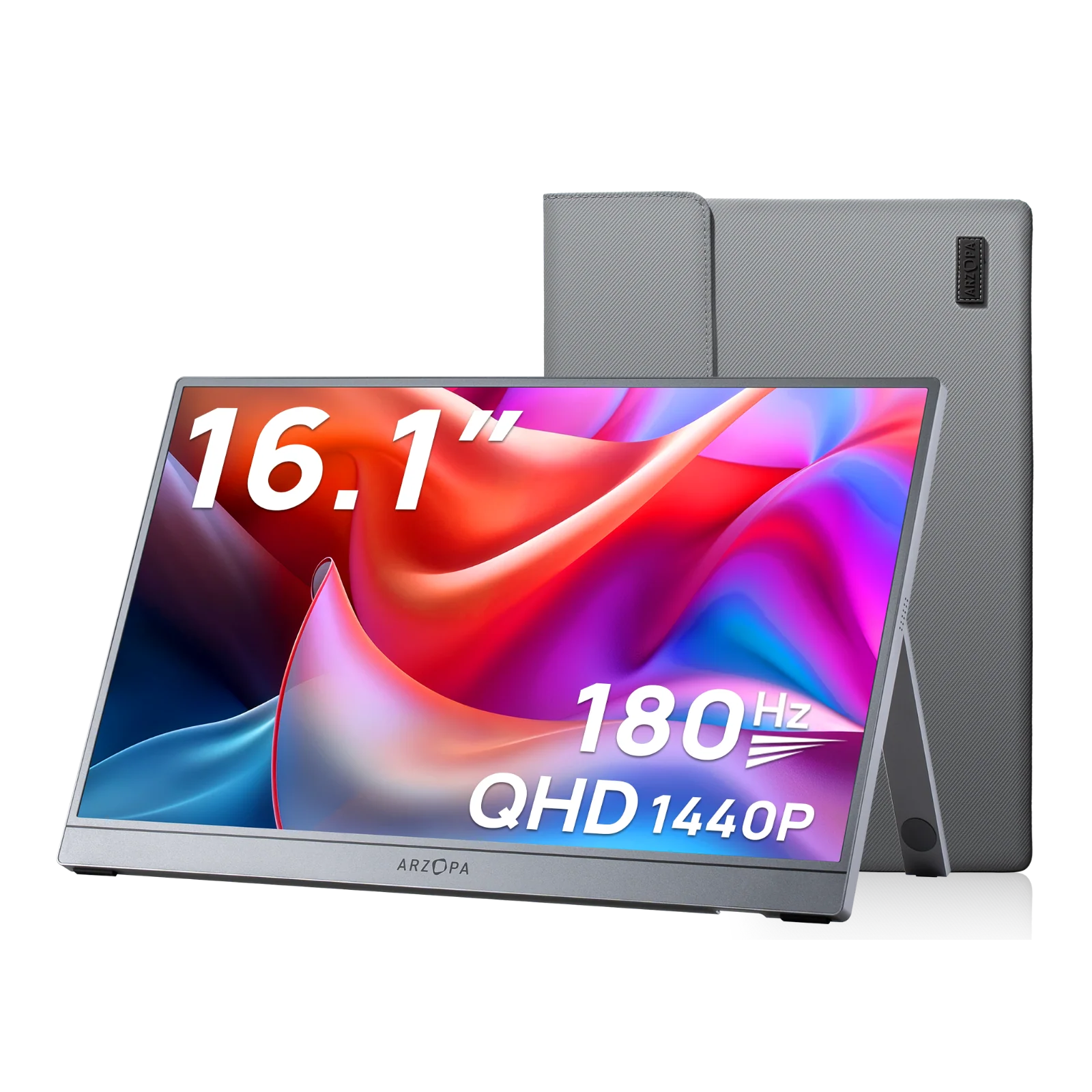
The Arzopa Z3FC is where resolution and refresh finally meet in a satisfying way: 16.1-inch, 2560 × 1440, and up to 180Hz. That combination lands right in the “best balance” zone for gaming — sharper than 1080p, easier to drive than 4K, and fast enough to feel genuinely competitive.
Conclusion
Selecting the best monitor resolution involves considering various factors, including your specific needs, monitor size, PC capabilities, and the impact of pixel density. By understanding the intricacies of monitor resolution and exploring the ideal resolutions for different use cases, you can make an informed decision that optimizes your visual experience while balancing performance and value. We hope this comprehensive guide has provided you with some insights into the world of monitor resolution like which screen resolution is best. If you have any further questions or would like to share your experiences, please feel free to leave a comment below. Don't forget to share this article with others who might find it helpful in their quest for the perfect monitor resolution!
Frequently Asked Questions (FAQs)
Will a higher resolution make everything look smaller?
Usually yes — at least at first. Higher resolution packs more pixels into the same space, so text and icons can shrink. That’s why operating systems use scaling to keep things readable.
Can some apps have compatibility issues on high-resolution monitors?
Yes. Most modern apps scale well, but some older software can still look blurry or awkward on very high-PPI displays.
Can I mix different resolutions in a multi-monitor setup?
Yes. Windows and macOS both support mixed-resolution setups. The main thing to watch is scaling consistency and cursor movement between screens.
Do higher-resolution monitors use more power?
Often a bit more, but resolution alone is not the whole story. Brightness, panel type, refresh rate, and screen size also affect power usage.
Do I need a specific cable for higher resolutions?
Yes. Cable and port bandwidth matter — especially for high refresh rates. 1440p high refresh and 4K high refresh often require better HDMI or DisplayPort versions.