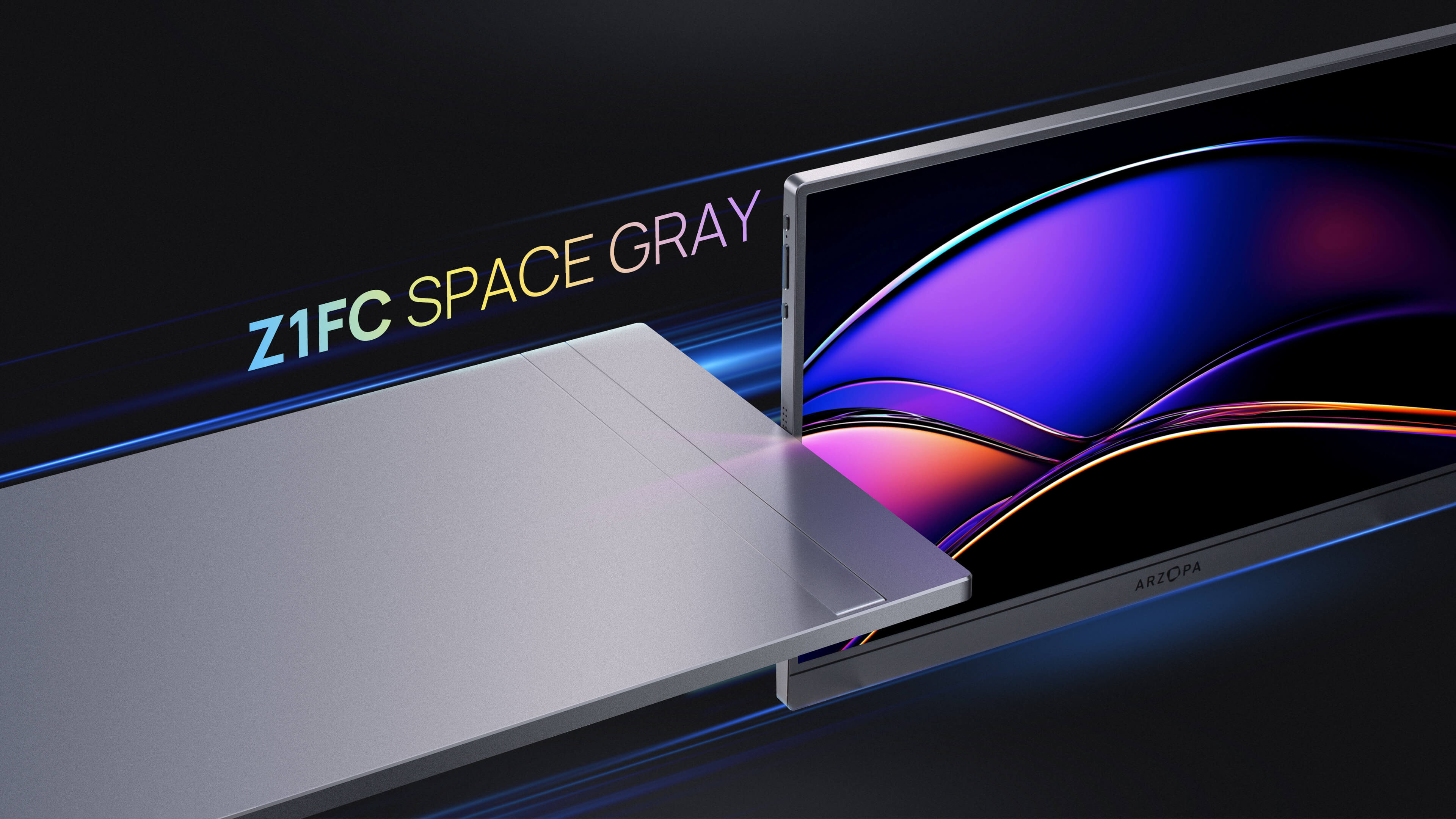

At a glance, the difference between portable gaming monitors and traditional desktop monitors is obvious: one is built for movement, the other is built for dominance on your desk.
Portable monitors are lightweight, slim, and designed to work anywhere. Traditional monitors, on the other hand, focus on performance, size, and immersive visuals.
If you're wondering are portable monitors worth it, here’s the short answer:
- Yes — if you value flexibility and productivity on the go.
- No — if you want maximum performance and immersion.
Portable monitors are not trying to replace desktop monitors. They solve a different problem. For many users, the best setup is actually a combination of both.
Key Differences Between Portable and Traditional Monitors
Feature |
Portable Gaming Monitor |
Traditional Monitor |
Portability |
Lightweight, travel-friendly |
Fixed, desk-bound |
Screen Size |
13"–18" |
24"–49"+ |
Performance |
Moderate (some high refresh options) |
High (better GPU pairing) |
Setup |
Plug-and-play (USB-C/HDMI) |
Requires full setup |
Use Case |
Work + gaming on the go |
Dedicated gaming/workstation |
Advantages of Portable Gaming Monitors
1. Improved Productivity Anywhere
I used to think my laptop screen was "enough"—until I actually tried a portable monitor. If you’ve ever spent hours squinting at a 13-inch display, constantly flipping through a dozen tabs, you know exactly how frustrating it gets. Your flow breaks, you lose your train of thought, and honestly, the inefficiency is enough to make you want to throw the laptop out the window.
A portable monitor pretty much makes those headaches disappear. It’s not just "extra screen space"; it’s a total reset for how you handle your workday:
Keep your "Deep Work" front and center: Your main document, design project, or complex dashboard stays locked on your primary screen. No more minimizing every 30 seconds.
Dump the "Noise" onto the side: Shove your Slack pings, email inbox, and endless reference tabs over to the second screen.
Instead of your workspace feeling like a cluttered mess, everything finally feels organized.
The biggest shift? You’re no longer "hunting for windows"—you’re actually getting things done. No more Alt+Tab fatigue, no more broken focus. Just a smooth, seamless workflow that actually keeps up with you.
2. True Portability and Flexibility
This is exactly why people buy a portable monitor in the first place. But "portable" doesn’t just mean it fits in a bag—it means it’s thin and light enough that you hardly notice it’s there. Nobody wants to head out for the day feeling like they’re carrying gym equipment. Beyond the weight, the real "magic" is how it lets you recreate a high-powered, dual-screen setup in seconds, no matter where you are.
You can whip it out basically anywhere:
At home: When you don’t have a massive, dedicated desk, you can still have a pro-level workspace on your kitchen table.
In co-working spaces: When all the extra monitors are taken, you’ve already got your own "unfair advantage" ready to go.
While traveling: Whether in a hotel or a cramped airport lounge, that second screen is a total lifesaver for staying in the zone.
During meetings: Instead of everyone huddling around one laptop, just flip the second screen toward your client.
A portable monitor isn't trying to replace your main desktop setup. It’s about making sure that when you’re away from your desk, you’re not stuck struggling with just one tiny screen.
3. Protecting Your Flow: No More "Brain Fog"
This might sound like a small detail, but once you experience it, there’s no going back.
When everything is crammed onto one screen, your brain is forced into a constant loop of "context switching":Working → Checking a message → Browsing a reference → Back to work.Those micro-interruptions add up. By the end of the day, you're not just tired—you’re mentally drained.
A second screen gives your brain a physical "Task Partition":
Primary Screen = Your Deep Work Zone: This is where your core focus stays—the document, the code, the design.
Secondary Screen = The Reference & Comm Hub: Everything else—Slack, emails, background music—stays in your peripheral vision, not in your face.
By separating the "action" from the "distraction," you stop interrupting yourself.
The real takeaway?It’s not just about doing more; it’s about staying in the zone longer. You’ll find yourself hitting that "flow state" easier and ending the day feeling way less fried.
4. Your "Anywhere" Gaming Station
Portable monitors aren't just for spreadsheets and emails—they’re surprisingly awesome for gaming, too.
To be clear, we’re not talking about replacing a $2,000 professional gaming rig. This is about flexibility. It’s about having the freedom to play without being tethered to a specific desk or fighting your family for the living room TV.
It basically plays nice with everything:
Consoles (Switch, PS5, or Xbox): Perfect for when you’re traveling or if the "main" TV is taken. Just plug in and you're back in the game.
Gaming Laptops: If your laptop screen feels a bit cramped, adding a second display for maps, guides, or Discord makes a world of difference.
Mobile Gaming: Some games just look and feel better when they’re not squeezed onto a smartphone screen.
The real "win" here? It’s having a pro-level setup that moves with you. Whether you’re chilling on the balcony, hiding in a quiet corner of the house, or stuck in a hotel room, you’ve always got a dedicated gaming station ready to go. It’s less about "ultimate specs" and more about the freedom to play whenever and wherever you want.
5. Level Up Your Meetings and Presentations
This is one of those features you don’t fully appreciate until you’re in the middle of a high-stakes call. A portable monitor doesn't just "show things"—it makes you look (and feel) a lot more prepared.
Think about those awkward moments when you’re sharing your screen and everyone sees your messy desktop or a private message. A second screen fixes that instantly:
Presentation Power: Keep your slides on the main display for your audience, while your private notes and timers stay on the second screen. No more "blind" presenting.
Video Calls Without the Chaos: Run your Zoom or Teams meeting on one display and keep your reference documents open on the other. You can answer questions instantly without frantically digging through folders.
Better Collaboration: If you’re in a small group, you don't have to huddle around one tiny laptop. Just flip the portable monitor toward the team—it’s a much more professional way to share.
It’s about control. Instead of fumbling through windows and breaking your flow, everything stays exactly where you need it. Even if you’re taking a meeting from a coffee shop, pulling out a second screen says, "I’ve got this handled."
The Reality Check: Who Is This NOT For?
We’d love to tell you a portable monitor is the solution to every problem, but let’s be real: it’s a specialized tool. It’s built for flexibility and secondary support, not for replacing a high-end, stationary powerhouse.
Peak Performance Trade-offs: If you live and die by millisecond latency for Competitive E-sports, or you're doing pixel-perfect color grading for a feature film, a portable screen isn't the right tool. It’s built for "gaming anywhere," not for winning a pro tournament from a coffee shop.
The Size & Immersion Gap: This is just physics. Most portable screens stay in the 13”–18” range to fit in your bag. While it's a lifesaver for multitasking on the go, it won't give you that "wrap-around" immersion of a 32-inch ultrawide. Think of it as your "Ultimate Sidekick," not a replacement for your desk setup.
The "Cable" Reality: "Plug-and-play" is the dream, but in the real world, compatibility varies. You might still need an extra cable depending on your device. And while wireless options exist, they aren't stable enough for high-performance tasks yet.
If your daily routine involves the following, a portable monitor might feel like it’s hitting a ceiling:
Competitive E-sports: If you live and die by millisecond latency or 240Hz+ refresh rates, you belong in front of a massive, dedicated gaming rig. Portable monitors are about "gaming anywhere," not winning a pro tournament from a coffee shop.
Hardcore Color Grading: While color accuracy has come a long way, if you’re color-correcting a feature film or doing pixel-perfect 3D rendering, a professional studio monitor is still your best bet.
Replacing a Full Desktop Setup: It’s not meant to be your only screen forever. Think of it as your "Ultimate Sidekick." It’s there to save the day in a hotel room, a cafe, or a cramped apartment—not to retire your 32-inch ultrawide.
A traditional monitor wins on "Peak Performance," but a portable monitor wins on "Versatility." It’s about having a pro-level experience in places where a traditional monitor simply can’t go.
Real-World Use Cases: Who Should Consider a Portable Monitor?
Choosing between these two depends entirely on your lifestyle. A portable monitor is the clear winner for:
Digital Nomads & Travelers: If your office changes every week, a lightweight screen is essential.
Hybrid Workers: Those who split time between home and the office need a consistent dual-screen experience.
Gamers on the Go: Pair an Arzopa portable monitor with a Steam Deck or a laptop for high-refresh gaming anywhere.
Students: Perfect for dorm rooms where desk space is at a premium.
Content Creators (Light Use): Useful for preview screens or script/reference display, but not ideal as a primary editing monitor.
For a deeper look at how a pro-grade portable screen performs, check out this review of the Arzopa Z3FC:
Arzopa Z3FC: The Gold Standard for 2026
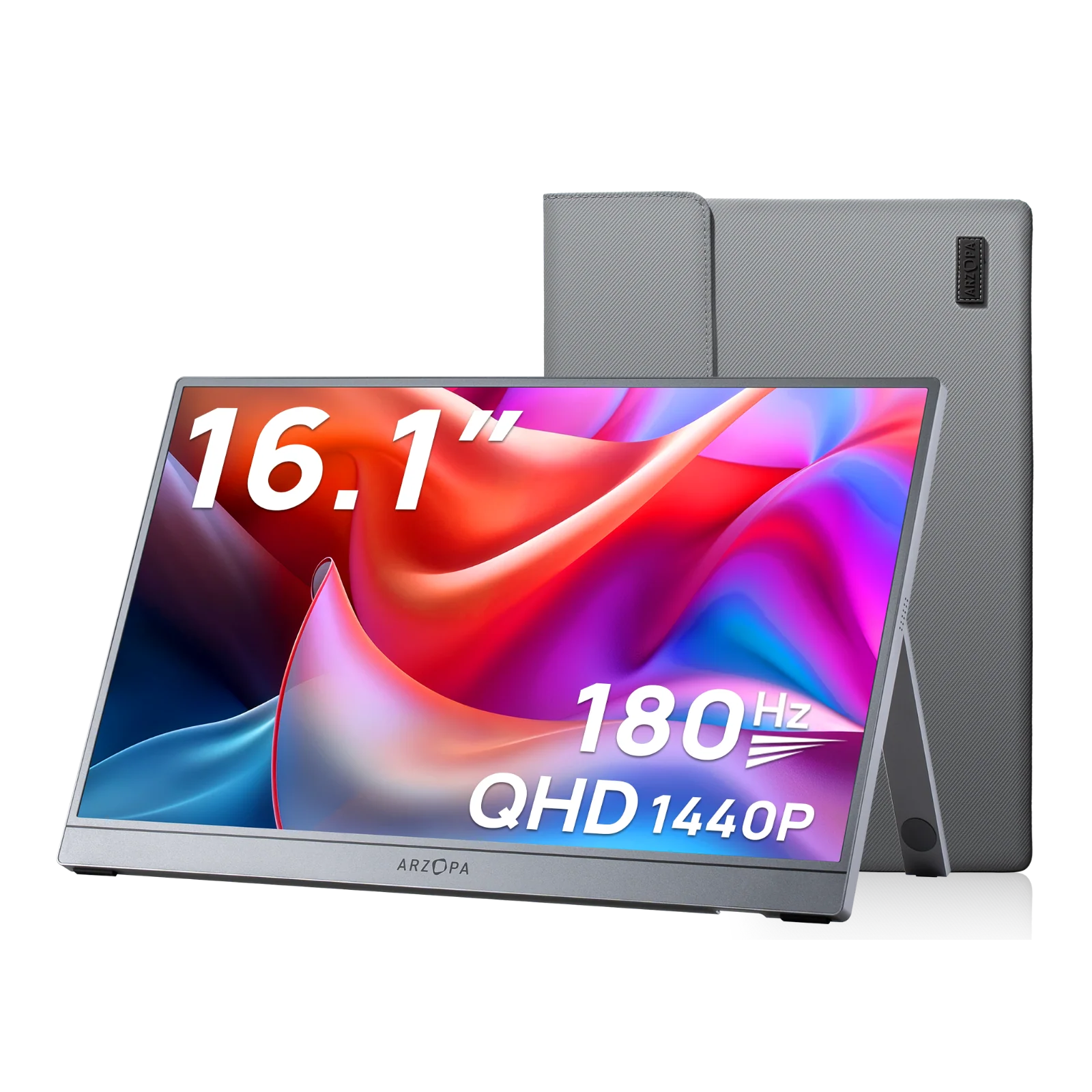
If you've decided that a portable setup is for you, the Arzopa Z3FC stands out as the best-in-class option. Unlike basic 1080p screens, the Z3FC offers a 2560x1440 QHD resolution. This means sharper text for office work and more vivid details for gaming.
The 180Hz refresh rate is particularly impressive. Most portable screens cap at 60Hz or 144Hz. At 180Hz, the Z3FC provides the fluid motion usually reserved for high-end desktop gaming rigs. It’s thin, lightweight, and features a built-in kickstand that makes it the ultimate companion for the Arzopa Z3FC product page.
Desktop Monitors: The Powerhouse Choice
1. Performance & Resolution
Desktop monitors offer several technical advantages that contribute to their superior performance compared to portable monitors. One significant advantage is their higher refresh rates, which typically range from 144Hz to 240Hz or even higher. This ensures smoother visuals and reduced screen tearing, making desktop monitors particularly important for gaming and video editing applications where high refresh rates are crucial for a seamless experience.

Another key advantage of desktop monitors lies in their panel types. Desktop monitors often feature high-quality panels such as IPS (In-Plane Switching), VA (Vertical Alignment), or TN (Twisted Nematic) panels. These panels provide better color accuracy, wider viewing angles, and higher contrast ratios, leading to more vivid and detailed visuals.

Maximum resolution is another area where desktop monitors excel. They can support resolutions up to 4K (3840 x 2160 pixels) or even 5K (5120 x 2880 pixels), providing incredibly detailed and crisp visuals. While portable monitors are capable of supporting high resolutions, they often have limitations due to their smaller size and lower pixel density, resulting in a less detailed and less immersive experience.
2. Comfort & Ergonomics
Desktop monitors provide better comfort and ergonomics through a variety of adjustable stand features that enhance the user experience for extended use. These features include height adjustment, tilt, rotational function, swivel, and adjustable arms.

- Height adjustment allows users to position the screen at a comfortable viewing height, reducing strain on the neck and back.
- Tilt function enables users to adjust the angle of the screen to reduce glare and reflections, which is particularly useful for users who work in environments with varying light sources.
- Rotational function allows users to switch between landscape and portrait modes, which is particularly useful for viewing documents or images in different orientations.
- Swivel feature allows users to adjust the position of the screen to face different directions, which is particularly useful for collaboration or presenting information to a group. The ViewSonic VA2446M-LED monitor offers a 120-degree swivel, making it easy to adjust the screen to face different directions.
- Adjustable arms allow users to position the screen in a variety of ways, which is particularly useful for users who need to work in different environments or who require a high degree of flexibility in their workspace.
3. Long-Term Investment
Desktop monitors offer a range of advantages that make them a long-term investment. Their durability, serviceability, and upgrade options ensure that they can withstand the demands of heavy use and keep pace with evolving technology, making them a cost-effective and practical choice for users who require a reliable and high-quality display.
In terms of color accuracy, portable monitors often struggle to match the performance of desktop monitors. They may have lower color gamut coverage, resulting in less vibrant and less accurate colors. Desktop monitors, by contrast, can offer much better color accuracy, with many modern models supporting wide color gamuts, such as Adobe RGB or DCI-P3, providing more accurate and vibrant colors.
Conclusion
Choosing between a portable monitor and a desktop monitor ultimately depends on your specific needs and preferences. Portable monitors offer unparalleled mobility and flexibility, making them perfect for digital nomads and frequent travelers. Desktop monitors, on the other hand, provide superior performance, comfort, and long-term value, making them ideal for gamers, content creators, and office setups.
By understanding the key differences between portable and desktop monitors, you can make an informed decision and create the optimal setup for your lifestyle and work requirements. Whether you prioritize portability or performance, there is a monitor solution that will meet your needs and exceed your expectations.
We hope this comprehensive guide has helped you better understand the world of portable and desktop monitors. If you have any further questions or would like to share your own experiences, please feel free to leave a comment below. Don't forget to share this article with your friends and colleagues who may be facing a similar decision!
Frequently Asked Questions
Q1: Why are portable monitors more expensive per inch than desktop ones?
A: It’s a fair question. If you’re looking at screen real estate alone, desktop monitors win. But with a portable monitor, you’re paying for miniaturization and high-end engineering. Making a screen thin, light, and durable enough to survive a backpack requires specialized materials and a much more complex manufacturing process. You're also paying for integrated tech like "One-Cable" Type-C connectivity and built-in kickstands. You're not just buying a screen; you're buying mobile productivity.
Q2: Will this actually work with my laptop? Any compatibility issues?
A: For 95% of modern devices, it’s a simple plug-and-play experience.
The Dream Setup: A single USB-C cable handles both power and video.
Older Devices: If your laptop is a bit of a veteran, you might need an HDMI cable plus a separate power source.Pro Tip: Check your laptop ports for a small "D" (DisplayPort) icon or a standard HDMI port. If you see either, you’re good to go. If you're unsure, just send us your laptop model—we'll check it for you!
Q3: Performance or Portability—which one should I prioritize?
A: It all comes down to where you do your best work.
If you spend 90% of your time at a dedicated desk and crave total immersion, go with a massive desktop monitor.
But if you're a "Digital Nomad," a frequent traveler, or just someone who likes to work from the couch occasionally, the portable monitor is a total game-changer.The Bottom Line: A desktop monitor offers a higher "performance ceiling," but a portable monitor gives you limitless freedom.