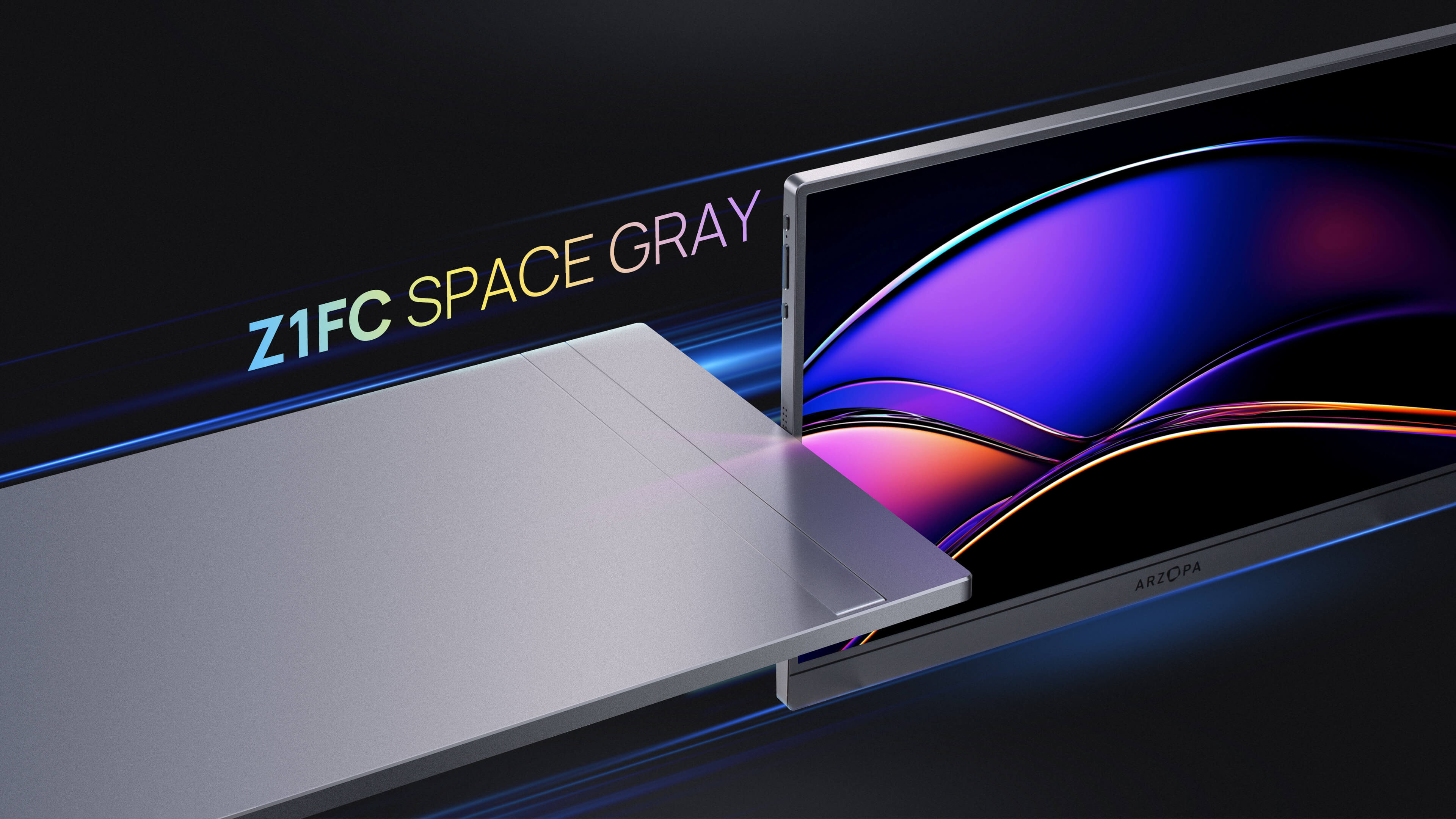
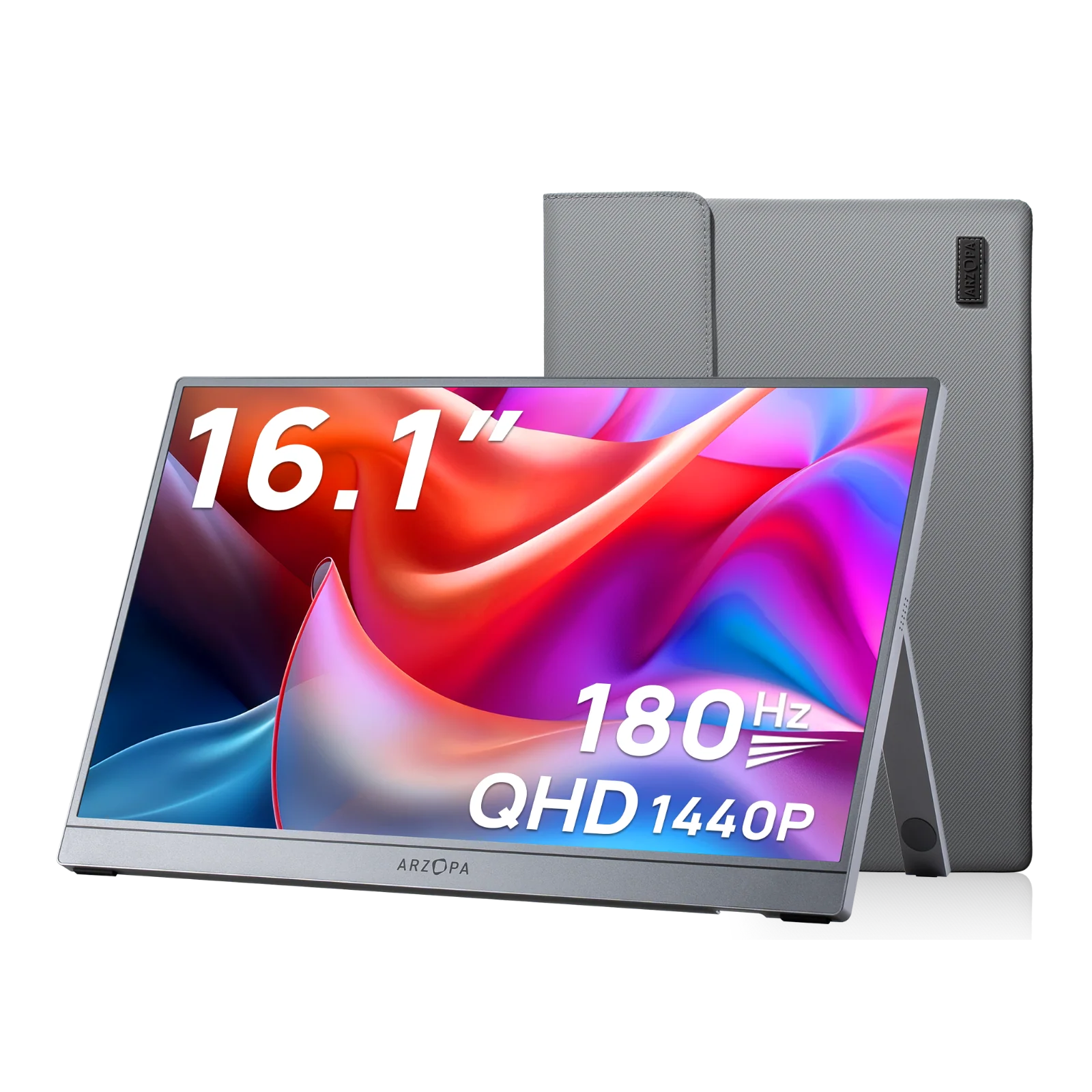

Have you ever experienced this? Sitting in a Starbucks or on a high-speed train, furiously Alt-Tabbing on a 13-inch laptop, looking up references while writing a document, wishing you could just split your screen in half; and then when you return home or to the office, facing a wide desktop, you find yourself torn between buying a massive “home anchor” monitor or sticking with a portable style?
As someone who needs to switch between different environments (home, office, business trips) as a worker and content creator, having dual screens is almost the only way to significantly boost efficiency. But here comes the question: should you choose a “portable monitor” that can go anywhere, or a “traditional monitor” that stands firm like a rock?
Today, we’re going to have a head-to-head comparison.

Portable Monitor or Desktop Monitor – What Are They?
Before diving into the comparison, we need to clarify their basic identities. After all, different types of monitors are inherently designed for different usage scenarios and work styles. If you don’t know what they are, what they look like, and what they are suitable for, talking about portability, display quality, or price differences later would be like building a castle in the air.
|
Core Dimension |
Portable Monitor (Portable) |
Traditional Monitor (Traditional) |
|
Design Philosophy |
Flexibility First |
Immersion First |
|
Best Use Case |
Mobile work, business trips, temporary meetings, dorms/rented spaces |
Fixed workstations, long-duration design/editing, AAA gaming |
|
Connectivity & Power |
Single-cable solution (depends on laptop/power bank, extremely simple) |
Independent power supply (more cables, more stable) |
|
Screen Size |
13" - 17.3" (focused view) |
24" - 32"+ (immersive view) |
|
Storage Difficulty |
Fits in a backpack, as portable as an iPad |
Almost immovable, occupies the desk space |
|
Performance Focus |
Sufficient and balanced: prioritizing energy efficiency and portability |
High-spec ceiling: pursuing high refresh rate, extreme color accuracy, and brightness |
What is A Portable Monitor

A portable monitor is not just a “laptop screen without a keyboard”; it’s designed to break free from limitations. Its core philosophy is “Go Anywhere,” making it the quintessential traveling monitor. Usually, it doesn’t have a heavy base, nor do you need to hunt for a wall socket—it can draw power and transmit signal directly through a single USB-C cable from your laptop or phone.
Its purpose is to let you, someone already accustomed to high-efficiency dual screens, maintain full productivity even when away from your fixed workstation. This is exactly where a portable laptop screen extender comes in handy, letting you set up a dual-screen workspace anywhere—even on a tiny café table or a train tray.
What is A Desktop Monitor (Traditional Monitor)
This is the familiar desktop “giant.” Its design philosophy is “Stay Here.” It requires a dedicated power plug and relies on a heavy base or VESA mount to be “fixed” on the desk. Once it’s settled, it basically won’t move for years. In exchange, it provides massive display real estate and extreme performance without worrying about power consumption. It’s the anchor in a fixed workstation that lets you immerse yourself confidently.
Core Dimension Showdown
1. Portability & Flexibility
This is the home court of portable monitors. Whether you’re a digital nomad turning a coffee shop corner into a coding station, or a business consultant needing to present PPTs at client sites, the demand for efficiency is the same.

This is where a dedicated portable monitor for travel truly shines. It isn't just a screen; it's a productivity tool that fits in your backpack. It allows you to deploy a fully functional dual-screen workstation anywhere—transforming a cramped hotel desk or a train tray table into a professional office in seconds.
In contrast, the “flexibility” of a desktop monitor is mostly limited to desk rotation or height adjustment. Want to take it on a trip? Unless you plan to turn your suitcase into a moving warehouse, forget it.
2. Display Quality
Here, traditional monitors have absolute dominance. Large 27" to 32" screens deliver full immersion. If you need to open three Excel files simultaneously or see every leaf flutter in a AAA game, the physical area advantage of a large monitor completely trumps smaller devices. It’s your IMAX in the desktop world.
But if we look from the perspective of display technology, the situation is more nuanced. A professional-grade OLED desktop monitor often costs thousands, even tens of thousands. Portable monitors, however, become the OLED democratizer. Many portable monitors provide top-tier color performance at a much more affordable price. For photographers and designers who need to handle color on the go, they can even serve as a professional color-calibrated screen you can carry anywhere.
3. Connectivity & Power
The strength of portable monitors lies in “one-cable simplicity.” A single USB-C cable handles both power and video transmission. But the downside is obvious: it drains your laptop’s battery—a true “power vampire.”
Desktop monitors, though more cable-heavy (HDMI/DP + power cable), often come with reverse charging. They don’t need your laptop for power; instead, they can charge your laptop via Type-C—a win-win.
And if you’re wondering, can I use a desktop monitor with my laptop? Absolutely—just make sure the ports match (HDMI, DisplayPort, or USB-C), and your laptop can extend its display to the desktop monitor. This is a common setup for mobile workers who combine portable and desktop monitors for a dual-screen workflow.
4. Ergonomics & Long-Term Experience
The advantage of monitors lies in stability. With a proper height-adjustable stand or arm, it maintains an ergonomic height for full-day use. But this stability also means heaviness. If you want to change posture, like reclining back, the screen rarely follows, and adjusting the stand may take two or three steps—or even some effort.
Portable monitors work the opposite way: they adapt to you, not the other way around. Just prop it up, and it becomes a portrait-screen wizard; switching between portrait and landscape or repositioning takes only seconds, no twisting of the stand or re-locking needed. For coding, reading long documents, or chat windows, this smooth switching is addictive.
More importantly, modern portable monitors have long moved beyond “relying on a simple sleeve for support.” Many models include VESA holes or magnetic backs. Combined with a small folding stand, you can easily raise it to eye level. Whether on a sofa, balcony, café table, or standing desk, it adapts to your environment—truly realizing ergonomic freedom anywhere.
desktop monitors must remain at the far end of the desk, whereas a portable monitor can be brought closer, even functioning as a touch input (if touch-enabled). This “near-field interaction” significantly improves dual-screen efficiency and reduces neck and head strain.
Who’s Your Match?
No monitor is an all-powerful king. They are not in a “better or worse” relationship—they are two tools designed for different lifestyles and work styles. So rather than agonizing over which is stronger, first look at what you truly need. Here’s a simple guide to help you quickly decide:
If you are…
-
Frequent traveler / consultant / photographer on the go: choose a portable monitor. Even if there’s only a corner of a hotel desk, it can help you efficiently handle Excel or preview photos.
-
College student / renter: with limited dorm or frequent moves, a portable monitor saves space and can even connect to a Switch for gaming. Pack it for holidays, take it home easily.

If you are…
-
Fixed office worker / designer / programmer / gamer: go with a traditional monitor without hesitation. Looking down at a small screen for long periods can ruin your neck and eyes. The productivity gain from a large screen is exponential.
Real-World Feedback: What the Community Says
Of course, don’t just take my word for it. A truly good product grows in users’ lives. When browsing Reddit’s r/DigitalNomad or Instagram’s #DeskSetup, you’ll see that discussions around portable monitors aren’t about dry specs—they’re about a sense of liberation:
“Rotate it vertically! Seriously, trust me! Placing the portable monitor next to my laptop for coding or reading papers is insanely efficient. No more constant Alt-Tabbing. One glance and I see the full picture. I can’t go back.” — Full-stack Developer
“As a minimalist, I was fed up with huge black plastic blocks (traditional monitors) on my desk. Now I pair a portable monitor with my laptop; when not in use, it folds like a book. My desk instantly clears. This ‘here when I need it, gone when I don’t’ order is a blessing for OCD types.” — Visual Designer
Summary & Recommendations
There’s no absolute “better” between portable and traditional monitors—only whether it fits your current needs. The safest approach is to consider your actual usage scenario: Where will you spend 80% of your time working? Do you value screen quality, portability, or comfort and efficiency most?
If your life combines a fixed office and mobile work, you can absolutely use a combination: a large, comfortable desktop monitor at home, and a portable laptop screen extender for travel or temporary expansion. This setup is often more flexible than choosing one type alone and suits modern hybrid work styles.
Regardless of your preference, try before buying. Check brightness, reflections, stand stability for portable monitors, and screen size and viewing distance for traditional monitors—these details aren’t always evident on spec sheets. Experiencing it firsthand will reveal which solution truly fits you.
(Bonus) My Personal Recommendation List
🎒 Portable Monitors (Mobile Work / Travel / Second Screen)
-
For Brand & Build Quality Enthusiasts – ASUS ZenScreen Series
Review: ASUS has deep experience in this field; build quality is solid and reliable. If your budget allows, you won’t go wrong. -
For Visual Perfectionists – Innocn (OLED models)
Review: If you are a photographer or care about display quality, these OLED models are stunning: deep blacks, vivid reds, and great value within this category. -
For Lightweight & Mobile Experience – Arzopa Z3FC
Review: Honestly, when designing the Z3FC, we aimed to solve the “portable anywhere” problem. We didn’t just pile on specs; we focused on extreme portability and mobile office experience. For those roaming the city with a backpack, Z3FC understands your pain points perfectly.
🖥️ Traditional Monitors (Fixed Workstation / Design / Heavy Gaming)
-
Office Standard – Dell UltraSharp Series
Review: First choice for company purchases; excellent stand and rich connectivity. Buy with confidence. -
Designer’s First Choice – BenQ PD Series
Review: Factory color calibration is very accurate; M-Book mode is ideal for Mac users. -
Budget-Friendly High Refresh/Entry Level – Xiaomi / Redmi Monitors
Review: Perfect first monitor for young users; excellent value, basic experience fully acceptable.
We hope this guide saves you time and helps you find the monitor that fits you best! If you found it useful, feel free to share it with friends who are struggling to choose the right gear.